Case Study
Rebuilding a beachfront resort's website from the ground up
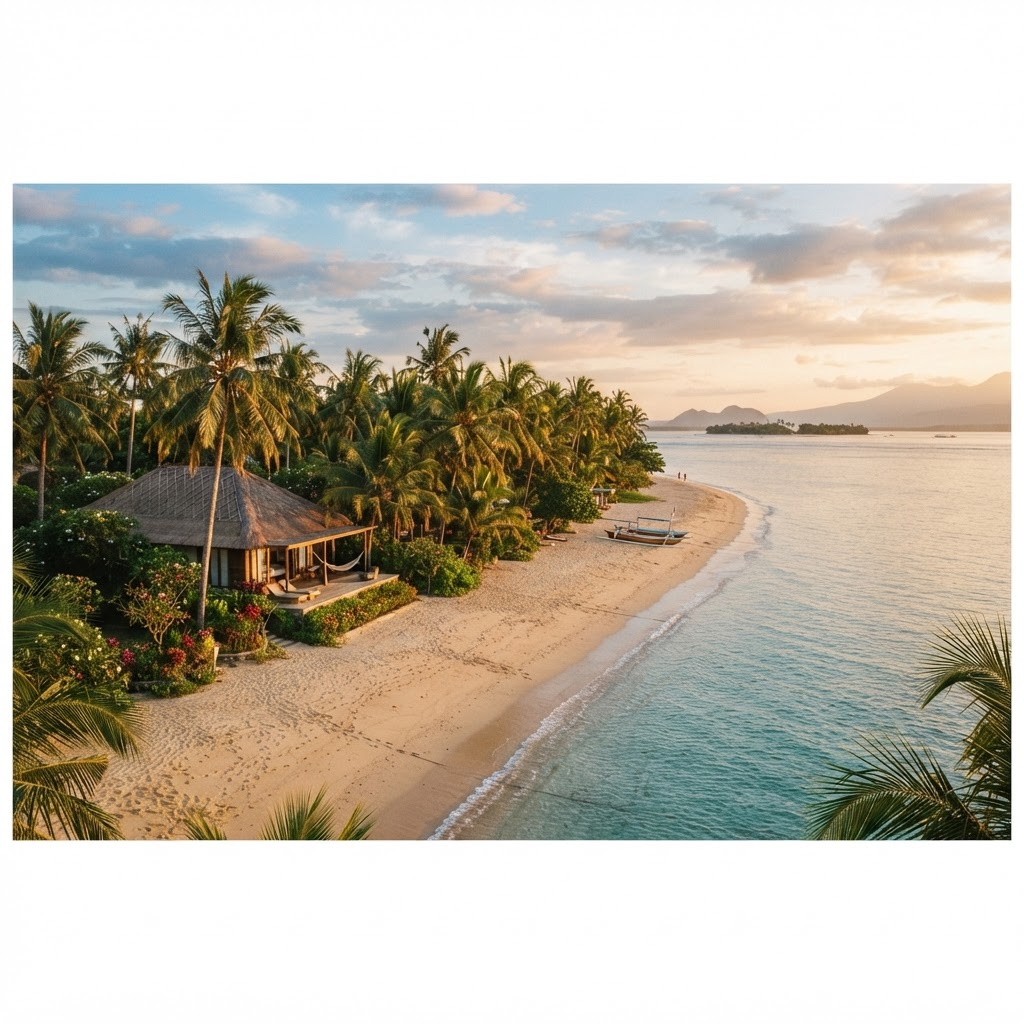
Holiday Resort Lombok asked for a full revamp of their old site. Instead of patching it, we rebuilt it on a fresh domain with a modern, conversion-first foundation — and made sure it's technically ready for how people (and AI) search today.
The Brief
An old site that no longer matched the resort
Holiday Resort Lombok's previous site at holidayresort-lombok.com had done its job for years, but it showed its age: dense, brochure-style paragraphs for every room type, generic "click here for more promo" links, and a layout that read more like a static directory listing than a resort built to convert lookers into direct bookings.
The brief was direct: modernize the design, make it convert better on both desktop and mobile, and make sure the new site is technically sound for search — not just for Google today, but for the AI answer engines guests are increasingly using to plan trips.
Rather than retrofit the existing platform, we rebuilt the resort's presence from scratch on a new domain, holidayresortlombok.com, giving us a clean foundation to design and build correctly from the first line of code.
Before & After
What actually changed
A direct comparison between the old site (holidayresort-lombok.com) and the new one (holidayresortlombok.com), based on what each site actually shows.
Each room type described in one long, unbroken marketing paragraph — hundreds of words before a guest reaches the actual facts.
Room facts (size, bed type, occupancy) shown as scannable icons up front, with inclusions as short bullet lists — the paragraph is optional context, not the only way to get information.
Calls to action were plain text links like "For more promo please click here," with no clear next step for a guest ready to book.
Every room, package, dining venue, and activity has its own booking or WhatsApp button — several pre-filled with a message specific to that section, so guests don't have to explain what they want twice.
No FAQ section and no structured data visible on the page — guest questions like "is there a private beach?" had no direct answer format.
A dedicated FAQ section answers the exact questions guests ask before booking, marked up with FAQPage schema so search and AI answer engines can lift the answer directly.
Guest ratings weren't surfaced on the page itself — reviews lived only on third-party platforms.
Live ratings from Agoda, TripAdvisor, Google, and Booking.com are shown directly on the homepage, alongside real guest quotes, so social proof is visible at the point of decision.
One flat page structure — everything about the resort competed for attention in a single scroll.
Dedicated pages for every room type, package, and dining venue, each with its own URL — giving search engines specific, indexable pages to rank instead of one page trying to rank for everything.
The Rebuild
A conversion-first layout, on every screen
Every section was designed to move a visitor one step closer to a direct booking — on a phone in a taxi or a laptop at a desk.
Booking bar built into the hero
Check-in and check-out pickers sit right on the homepage hero, so the first thing a visitor can do is start checking availability — no hunting for a booking page.
Swipeable on mobile, tabbed on desktop
Rooms, dining venues, packages, and attractions each adapt their browsing pattern to the device — horizontal swipe carousels on mobile, sidebar tabs on desktop — instead of one layout squeezed to fit both.
Context-aware WhatsApp buttons
The WhatsApp button on the spa page opens with a spa-specific message, the one on the cooking class asks about the cooking class — every section pre-fills the conversation instead of starting from zero.
A real reason to book direct
A dedicated "Why Book Direct" section lays out the best-rate guarantee, flexible cancellation, and direct support — reasons for a guest to book on-site instead of leaving for an OTA.
Sustainability made visible
The resort's eco farm, reef restoration, and community partnerships get their own section with a photo and copy — a genuine part of the resort's story that the old site never told on-page.
One design system, every page
Rooms, dining, spa, packages, and attractions all share the same visual language and interaction patterns, so the site feels like one coherent brand instead of pages bolted on over time.
Built to Be Found
Ready for search, answer, and AI engines — not just Google
SEO, AEO, and GEO tackle three different ways people now find a business. Here's what each one means, and exactly what's already in place on the new site.
SEO — Search Engine Optimization
The classic discipline of ranking in traditional search results: making sure Google (and Bing) can crawl, understand, and rank every page for the right keywords.
- A generated sitemap.xml listing every room, package, and dining page individually, with priority and last-modified dates.
- Unique meta titles, descriptions, and Open Graph tags per page, plus canonical and hreflang tags so search engines know which URL is authoritative.
- A robots.txt that explicitly allows Googlebot and Bingbot full access, with no blocked sections that would hide content from indexing.
AEO — Answer Engine Optimization
Optimizing for the moment a search engine or voice assistant tries to answer a question directly, instead of just linking to a page — think Google's featured snippets or a voice search reply.
- A dedicated FAQ section built from the real questions guests ask — location, family-friendliness, private beach access, check-in times, all-inclusive options.
- Every FAQ answer is marked up with FAQPage structured data (schema.org), the exact format answer engines look for to extract a direct response.
- Resort-level structured data (schema.org/Resort) states check-in/check-out times, amenities, and location as clean, unambiguous facts rather than prose an engine has to interpret.
GEO — Generative Engine Optimization
Making sure AI systems like ChatGPT, Claude, and Perplexity can actually access and cite the site when a traveler asks them for a resort recommendation — the newest and least understood of the three.
- robots.txt explicitly allows the major AI crawlers by name — GPTBot, ClaudeBot, PerplexityBot, Google-Extended, Applebot-Extended, and Amazonbot among them — rather than leaving them to guess or blocking them by default.
- Structured data gives generative engines verifiable facts to cite directly — aggregate rating, geo-coordinates, room count, and amenities — instead of forcing them to summarize marketing copy.
- Content is written in clean, scannable sections rather than dense paragraphs, which is easier for a language model to parse accurately when generating an answer about the resort.
The new site only just went live, so Google and the AI crawlers haven't fully indexed or cited it yet — that takes time regardless of how a site is built. What matters is that every technical signal is already in place, so the site is ready to be discovered the moment those systems come around.
Want a site rebuilt like this one?
Whether it's a hotel, villa, or any local business, this is the same process we bring to every project — modern design, a booking flow that actually converts, and the technical groundwork for search, answers, and AI.